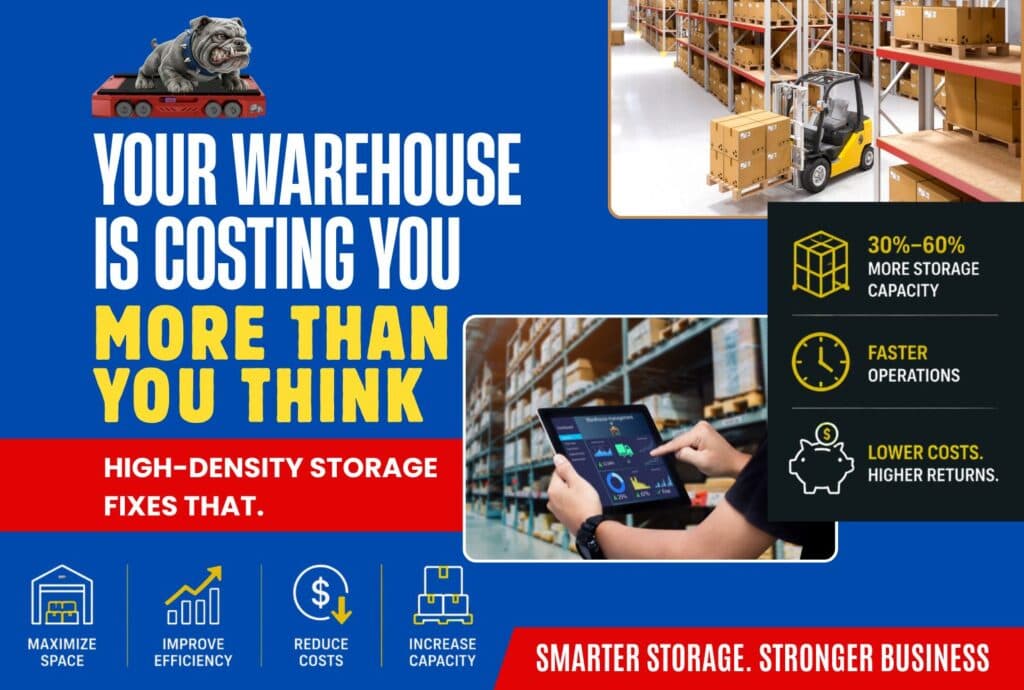
Your warehouse could be costing you more than you realize.
The Problem
Traditional racking uses only 30-40% of available space. You're paying for empty air.
Hidden Costs
- Wasted vertical space
- Wide forklift aisles (12-14 ft)
- Underused overhead clearance
- Excessive travel time = labor cost
- Off-site storage leases
The Fix
High-density storage increases capacity 60-80% without expanding your footprint.
Solutions
- Drive-in/push-back racking
- 4D shuttle systems
- Narrow aisle conversions
- Rack-supported mezzanines
Stop paying rent on air. Make every cubic foot work.
Many warehouse operators do not realize how much money they are losing to inefficient storage. The costs are not always obvious—they do not show up as a single line item on a P&L statement. Instead, they hide in elevated rent-per-pallet ratios, excess labor hours, off-site storage leases, and the slow erosion of throughput that comes from a facility operating beyond its practical capacity.
The uncomfortable truth: most warehouses are using only 35-45% of their available cubic space. That means for every dollar you spend on your facility, more than half is paying for empty air.
The Hidden Costs of Inefficient Storage
Let us break down where the money actually goes:
1. Wasted Vertical Space
Conventional selective racking typically uses 3-4 beam levels in a building with 30-36 feet of clear height. The space above the top beam level—often 6-10 feet of usable height—sits empty. That is not just wasted space; it is wasted rent, wasted heating and cooling, and wasted insurance cost. Every foot of unused height in a 100,000 sq ft warehouse represents roughly $0.50-1.00 per square foot per year in wasted occupancy cost.
2. Wide Forklift Aisles
Standard sit-down counterbalanced forklifts require 12-14 foot aisles. In a typical selective racking layout, aisle space consumes 50-60% of the floor. You are essentially renting twice the space you need for storage because half the building is dedicated to forklift maneuvering room. Narrow aisle (VNA) and very narrow aisle systems can reduce aisle width to 6-8 feet, effectively doubling your usable storage area.
3. Excessive Travel Time
Inefficient layouts force forklift operators to travel farther for every put-away and retrieval. In a poorly organized warehouse, forklift travel can account for 60-70% of an operator's shift—time spent driving, not handling product. At an average fully loaded labor cost of $25-35/hour including benefits and equipment, excessive travel time in a 20-forklift operation can cost $200,000-400,000 per year in wasted labor.
4. Product Damage
Every additional forklift movement is an opportunity for product damage. Double-handling, tight maneuvering in crowded aisles, and rushed operations in overloaded facilities all increase damage rates. For most warehouse operations, product damage runs 0.5-2% of throughput value. In a $50M annual throughput operation, that is $250,000-1,000,000 per year in preventable loss.
5. Off-Site Storage
When your warehouse runs out of room, the typical response is leasing off-site storage. The direct costs are obvious—rent, utilities, insurance. The hidden costs are worse: transportation between facilities, split inventory management, additional handling cycles, and the inevitable picking and shipping errors that come from managing inventory across multiple locations. Off-site storage typically costs 2-3X more per pallet position than in-house storage when all costs are factored in.
6. Opportunity Cost
This is the big one that rarely gets measured. When your warehouse is at capacity, you cannot take on new customers, accept surge orders, or build safety stock. Every piece of business you turn away or delay because of space constraints is lost revenue—and it often goes to a competitor who has invested in efficient storage.
How High-Density Storage Fixes It
High-density storage is not a single product—it is a design philosophy that maximizes usable pallet positions per cubic foot of building. Here is how different high-density solutions address each hidden cost:
Drive-In and Push-Back Racking
These systems eliminate intermediate aisles by storing pallets 2-10 deep. Drive-in racking is ideal for large quantities of the same SKU (LIFO access), while push-back racking offers lane depths of 2-6 deep with LIFO access from the aisle face. Both can increase pallet positions by 40-60% in the same footprint compared to selective racking.
4D Shuttle Systems
The most flexible high-density option. 4D shuttles store pallets deep in lanes (like drive-in) but with the ability to access any pallet position (like selective). They eliminate forklift entry into the rack, reduce product damage, and can operate in FIFO or LIFO mode. Storage density increases of 60-80% are typical, with the added benefit of reduced labor costs since the shuttle handles put-away and retrieval autonomously.
Narrow Aisle and Very Narrow Aisle (VNA) Systems
By switching from standard forklifts to reach trucks or turret trucks, aisle width drops from 12-14 feet to 6-8 feet. The same building suddenly has 30-40% more usable storage area. VNA systems also improve picking accuracy with wire-guided or rail-guided equipment that eliminates the operator error associated with wide-aisle free-roaming forklifts.
Rack-Supported Mezzanines and Multi-Level Systems
When floor space is constrained, building up is the answer. Rack-supported mezzanines add a second or third level of storage or picking activity within the same building footprint. Combined with conveyors or shuttle systems for vertical movement, these systems can double or triple usable space without expanding the building.
The ROI Math
Let us run a simple example for a 100,000 sq ft warehouse:
- Current state: 4,000 pallet positions using selective racking at $8/sq ft annual occupancy cost = $800,000/year facility cost, or $200/pallet position/year.
- After high-density conversion: 7,200 pallet positions (+80%) in the same footprint. Same $800,000 facility cost, but now $111/pallet position/year.
- Annual savings: The additional 3,200 positions at the off-site equivalent cost of $350/position/year = $1,120,000 in avoided off-site storage cost.
- Additional savings: Reduced forklift travel, lower product damage, and eliminated double-handling conservatively add another $150,000-250,000 annually.
Total annual benefit: $1.27-1.37 million. Against a typical high-density racking investment of $1.5-2.5M, payback is achieved in 12-24 months.
The Bottom Line
Your warehouse is almost certainly costing you more than you think. The hidden costs of wasted space, excessive travel, product damage, and off-site storage add up to hundreds of thousands—sometimes millions—of dollars per year. High-density storage solutions from Bulldog Rack can cut those costs dramatically while increasing your capacity, throughput, and operational flexibility.
Contact Bulldog Rack for a free storage utilization assessment. We will analyze your current layout, identify the hidden costs, and model the ROI of a high-density conversion specific to your operation.