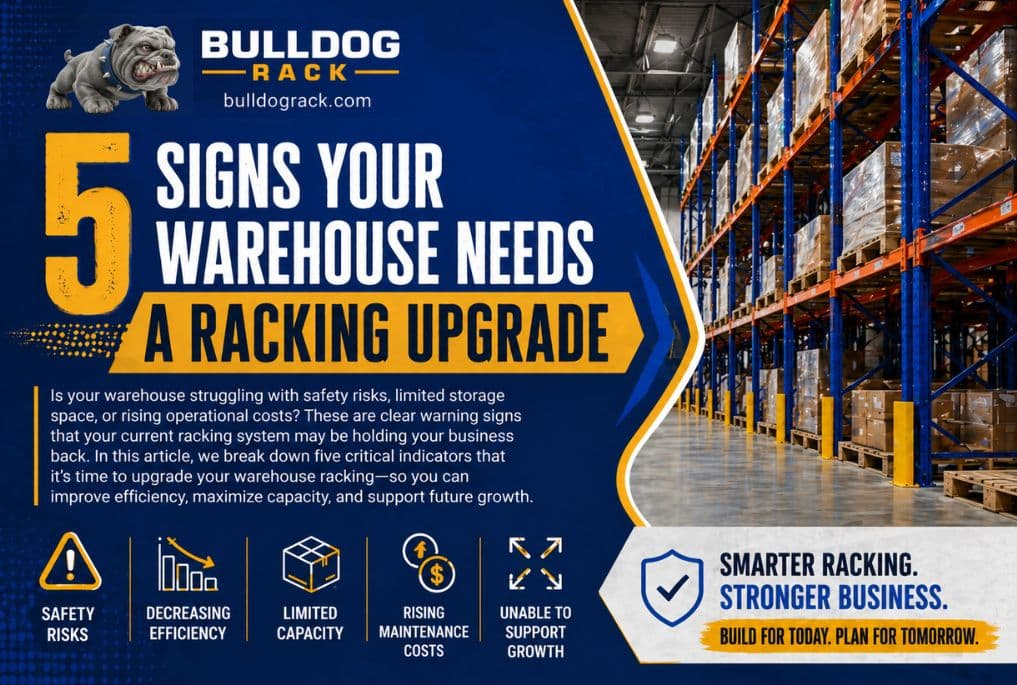
Is your racking holding you back? Five warning signs:
1. Running Out of Space
If you're considering off-site storage or expansion, your racking may not be maximizing what you have. High-density systems can increase capacity 60-80%.
2. Safety Concerns
Damaged uprights, bent beams, and overloaded shelves are accidents waiting to happen. OSHA citations average $15,000+ per violation.
3. Slow Picking
Excessive forklift travel means your layout is wrong. Optimized racking cuts travel time 25-40%.
4. Inventory Changed
10-year-old racking was designed for products you may no longer carry. Pallet sizes, weights, and SKU mix evolve.
5. Rising Maintenance
Constant repairs and temporary fixes cost more than upgrading. If annual maintenance exceeds 8-10% of replacement value, it's time.
One sign is a concern. Two or more is a clear signal to act.
Your warehouse racking is the backbone of your entire operation. Every product you store, every order you pick, and every pallet you ship depends on a racking system that was designed for a specific set of conditions. When those conditions change—or when the racking itself deteriorates—the entire supply chain suffers.
Here are five clear signs that your warehouse racking needs an upgrade, along with what each warning sign actually costs you and how to address it.
1. You Are Running Out of Space
This is the most visible sign, and it is also the one most commonly addressed the wrong way. When pallets start accumulating in aisles, staging areas overflow, and the conversation shifts to leasing off-site storage or building an expansion, the instinct is to add more square footage.
But here is the question most companies skip: are you using the space you already have?
In most warehouses, the answer is no. Conventional selective racking typically utilizes only 35-45% of available cubic space. The remaining 55-65% is a combination of:
- Unused vertical space above the top beam level
- Wide aisles consuming 50%+ of the floor area
- Fixed beam heights that do not match current pallet profiles
- Lanes designed for products you no longer carry
Before spending millions on expansion or off-site leases, a high-density racking conversion—drive-in, push-back, pallet flow, or shuttle systems—can increase your pallet positions by 60-80% in the same footprint. That is often enough to defer or eliminate the expansion entirely.
The cost of ignoring it: Off-site storage typically costs 2-3X more per pallet than in-house storage. A 500-pallet overflow at $350/position/year = $175,000 annually in avoidable off-site costs.
2. Safety Concerns Are Mounting
Racking damage is not just a cosmetic issue—it is a safety hazard and a liability exposure. The warning signs include:
- Bent or twisted uprights—Often caused by forklift impacts, these compromise the load-bearing capacity of the entire bay.
- Deflected or sagging beams—Indicates overloading or fatigue, both of which can lead to catastrophic collapse.
- Missing or damaged safety clips—Beam-to-upright connections without functioning safety clips can dislodge under load.
- Rust and corrosion—Particularly in cold storage, food processing, or high-humidity environments, corrosion weakens structural components over time.
- Shim stacks and field repairs—Temporary fixes that have become permanent. If your maintenance team is shimming uprights or welding patches, the system is telling you it needs replacement.
OSHA takes racking safety seriously. Citations under the General Duty Clause for unsafe racking conditions average $15,000+ per violation, and willful violations can reach $156,000. A rack collapse that injures a worker can result in criminal liability, lawsuits, and operational shutdowns that cost far more than a racking upgrade.
The cost of ignoring it: Beyond the human cost, a single rack collapse can cause $500,000-2,000,000+ in product damage, facility repair, operational downtime, and legal exposure.
3. Picking Times Are Increasing
If your fulfillment times are getting longer despite no change in order volume, the problem is likely your racking layout—not your people. The symptoms:
- Forklift operators spending 60%+ of their shift traveling rather than putting away or retrieving pallets.
- Long dead-runs—trips with an empty forklift because high-velocity SKUs are scattered across the warehouse instead of positioned near shipping.
- Congestion in popular aisles—multiple forklifts competing for access to the same lanes because fast-movers are not properly slotted.
- Excessive double-handling—product moved from storage to staging to shipping instead of a direct path.
A racking upgrade is not just about more capacity—it is about better layout. Proper slotting analysis combined with the right mix of racking types (selective for high-SKU picks, high-density for bulk, flow rack for FIFO) can reduce forklift travel by 25-40% and increase picks per labor hour by a similar margin.
The cost of ignoring it: In a 15-forklift operation at $30/hour fully loaded, a 30% travel reduction saves approximately $200,000/year in labor alone.
4. Your Inventory Mix Has Changed
The racking system that was perfect when it was installed may be completely wrong for what you are storing today. Inventory profiles evolve:
- Pallet sizes changed—You shifted from standard 48x40 pallets to 48x48 or specialty sizes, but your beam spacing has not changed.
- Weights changed—Product weights have increased, but your racking was engineered for lighter loads. Every overloaded beam is a potential failure point.
- SKU count grew—You had 200 SKUs when the racking was installed; now you have 2,000. The same deep-lane configuration that worked for bulk storage is a nightmare for high-SKU picking.
- Temperature zones shifted—You added refrigerated or frozen product lines, but the racking in those zones was not designed for cold storage environments (different steel grades, finishes, and load ratings).
- Product dimensions changed—Taller products, wider products, or irregular shapes that do not fit cleanly between existing beam levels, resulting in wasted vertical space.
When racking does not match inventory, you get one or more of: wasted space from poor beam-height fit, safety risks from overloaded or improperly supported loads, and operational inefficiency from picking processes that fight against the physical layout.
The cost of ignoring it: A mismatched rack profile wastes 15-25% of usable pallet positions through poor beam height utilization alone. In a 5,000-position warehouse, that is 750-1,250 positions lost.
5. Maintenance Costs Are Rising
Every racking system requires some maintenance. But there is a clear line between routine upkeep and a system that is telling you it is past its useful life:
- Replacement parts are becoming harder to source—Older racking systems use proprietary components that manufacturers may no longer produce.
- Repair frequency is increasing—If you are replacing uprights, beams, or connectors more than twice a year, the system is degrading faster than you can fix it.
- Repair costs are approaching replacement costs—Industry rule of thumb: when annual maintenance exceeds 8-10% of the replacement value of the racking, it is more economical to replace than to keep repairing.
- Temporary fixes are becoming permanent—Bolted plates, welded reinforcements, and load reduction signs are not maintenance; they are life support.
- Insurance inspections are flagging issues—If your insurer is noting racking conditions in their audit reports, it is a matter of time before premiums increase or coverage conditions change.
A proactive racking upgrade is always cheaper than a reactive emergency replacement after a failure. Planned upgrades allow you to stage the work around operations. Emergency replacements shut you down.
The cost of ignoring it: A planned racking upgrade costs 30-50% less per position than an emergency replacement, and avoids the operational downtime that a failure-driven replacement forces.
What to Do Next
If you recognize one or more of these signs in your warehouse, here is the action plan:
- Get a professional racking assessment—Bulldog Rack provides on-site evaluations that document current conditions, identify safety issues, and quantify the capacity you are leaving on the table.
- Model the ROI—We will show you the financial comparison between continuing to maintain your current system versus upgrading, including labor savings, capacity gains, and avoided off-site storage costs.
- Design the upgrade in phases—You do not have to shut down to upgrade. Bulldog Rack designs phased installation plans that keep your operation running while the new system goes in.
- Plan for the next 10-15 years—The best time to design for future growth is during the upgrade. We engineer systems that accommodate your current needs and your projected growth, so you are not back in this position in five years.
Contact Bulldog Rack for a free warehouse racking assessment. We will tell you exactly where you stand and what a strategic upgrade looks like for your operation.