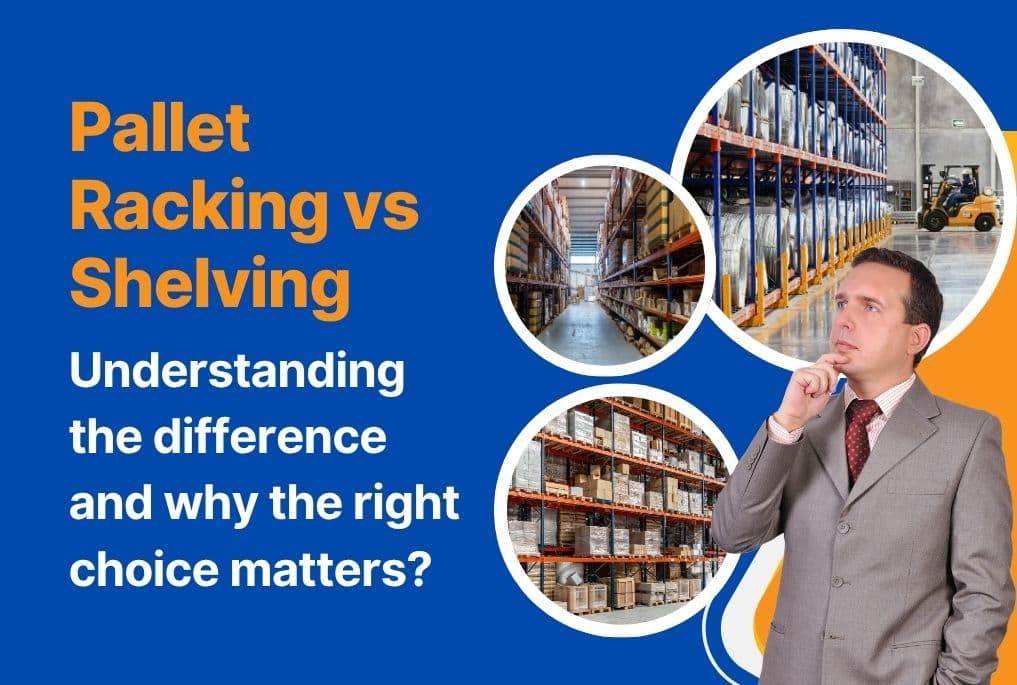
Pallet Racking
Heavy palletized loads, forklift-accessed, high-volume distribution. 2,000-5,000+ lbs per level.
Shelving
Smaller items, hand-picking, parts storage, e-commerce. Up to 500-1,000 lbs per shelf.
Key Differences
- Load: Racking handles pallets; shelving handles cartons and pieces
- Access: Racking needs forklifts; shelving is manual pick
- Height: Racking reaches 30+ ft; shelving typically 7-10 ft
- Cost: Racking is higher per bay; shelving costs more per cubic foot stored
Best Choice?
Many operations use both. Pallet racking for bulk reserve, shelving for pick faces and small parts. We design hybrid solutions.
When setting up or optimizing a warehouse, one of the fundamental decisions is whether to use pallet racking, shelving, or a combination of both. They are not interchangeable—each system is engineered for different load types, access methods, and operational workflows. Choosing wrong means wasted space, inefficient labor, and potentially unsafe conditions.
This guide breaks down the differences so you can make the right decision for your operation.
Pallet Racking: Built for Heavy, Palletized Loads
Pallet racking systems are designed to store full pallets of product, accessed by forklifts, reach trucks, or automated systems. They are the backbone of distribution centers, manufacturing storage, and any operation that moves product in pallet quantities.
Key Characteristics
- Load capacity: 2,000 to 5,000+ lbs per beam level, depending on beam size and span.
- Height: Typically 16-36 feet, utilizing the full clear height of the building. High-bay installations can reach 40+ feet.
- Access method: Forklift, reach truck, turret truck, or automated shuttle/crane.
- Unit of storage: Standard pallets (48x40, 48x48, etc.) or custom pallet sizes.
- Types: Selective, drive-in, push-back, pallet flow, shuttle systems, and cantilever.
Best Use Cases
- Bulk storage and distribution—Storing and shipping full pallets of product.
- Manufacturing raw materials—Steel, components, packaging materials on pallets.
- Reserve storage—Backup inventory above the pick line in a multi-level warehouse.
- Cold storage and freezer—Pallet racking with shuttle systems maximizes density in expensive temperature-controlled space.
- 3PL and multi-client warehouses—Configurable bays accommodate different clients and product profiles.
Pros
- Maximum use of vertical space—stores product from floor to ceiling.
- High capacity per square foot of floor space.
- Wide range of configurations for different inventory profiles.
- Designed for forklift access—fast put-away and retrieval.
Cons
- Requires forklift equipment and trained operators.
- Wide aisles for standard forklifts reduce floor utilization (narrow aisle options mitigate this).
- Not practical for individual piece-picking or small-item storage.
- Higher cost per bay than shelving (but lower cost per pallet stored when density is factored in).
Shelving: Built for Smaller Items and Hand-Picking
Shelving systems store cartons, totes, parts, and individual items at heights accessible by hand or with the help of ladders, pick carts, or mezzanine walkways. They are essential for e-commerce fulfillment, parts distribution, retail backrooms, and any operation that picks individual items rather than full pallets.
Key Characteristics
- Load capacity: 250 to 1,000 lbs per shelf, depending on shelf type and span.
- Height: Typically 7-10 feet for single-level, or 14-20 feet with mezzanine or multi-tier systems.
- Access method: Manual (hand-picking), sometimes assisted by pick carts, ladders, or goods-to-person systems.
- Unit of storage: Cartons, totes, bins, individual pieces.
- Types: Boltless rivet shelving, steel clip shelving, wire shelving, modular drawer systems, carton flow shelving.
Best Use Cases
- E-commerce fulfillment—High-SKU, piece-level picking at ergonomic heights.
- Parts distribution—Automotive, industrial, and electronics parts stored in bins and cartons.
- Retail backrooms—Organizing overstock and replenishment inventory.
- Archive and document storage—Carton-level storage of records and files.
- Maintenance and repair operations (MRO)—Organizing tools, spare parts, and consumables.
Pros
- No forklift required—lower equipment costs and no operator licensing.
- Excellent for high-SKU, small-item operations.
- Easy to install and reconfigure.
- Lower cost per bay than pallet racking.
Cons
- Cannot handle pallet-level loads.
- Limited height without mezzanine systems, wasting vertical space.
- Lower storage density per cubic foot compared to pallet racking for bulk storage.
- Manual picking is labor-intensive for high-volume operations.
Head-to-Head Comparison
| Factor | Pallet Racking | Shelving |
|---|---|---|
| Load per level | 2,000-5,000+ lbs | 250-1,000 lbs |
| Height utilization | Floor to ceiling (30+ ft) | 7-10 ft (20+ ft with mezzanine) |
| Access method | Forklift / automated | Hand pick / cart |
| SKU density | Low-Medium per bay | High per bay |
| Picking speed | Fast for pallets, slow for pieces | Fast for pieces, N/A for pallets |
| Equipment needed | Forklifts, reach trucks | Pick carts, ladders |
| Cost per bay | Higher | Lower |
| Cost per unit stored | Lower (bulk) | Higher (per item) |
The Hybrid Approach: Why Most Operations Need Both
In practice, very few warehouses are 100% pallet racking or 100% shelving. Most operations benefit from a hybrid layout:
- Reserve storage in pallet racking—Full pallets of inventory stored at height, accessed by forklift for replenishment.
- Pick faces in shelving—Carton- or piece-level pick positions at ergonomic heights, replenished from the pallet reserve above or behind them.
- Mezzanine-mounted shelving—Adding a second or third level of shelving above the ground floor for high-SKU operations, with pallet racking underneath for bulk reserve.
- Carton flow shelving in front of pallet racking—Gravity-fed pick positions on the aisle face with pallet reserve behind, creating an integrated pick-and-replenish workflow.
The key is designing the two systems together as a single integrated solution, not bolting shelving onto the end of a pallet racking project as an afterthought.
Decision Framework
Use these questions to guide your choice:
- What are you storing?—Full pallets = racking. Cartons, pieces, parts = shelving. Both = hybrid.
- How do you pick?—Full pallet out = racking. Piece-level or carton-level = shelving pick face.
- How many SKUs?—Under 100 SKUs in bulk quantities = racking-heavy. Over 1,000 SKUs in small quantities = shelving-heavy.
- What is your clear height?—If you have 30+ feet of clear height and are only using shelving, you are wasting 60%+ of your building. Pallet racking above shelving recovers that space.
- What is your budget?—Shelving has lower upfront cost per bay, but racking delivers lower cost per unit stored at scale. Model the total cost of ownership, not just the purchase price.
The Bottom Line
Pallet racking and shelving are not competitors—they are complementary systems that serve different functions in a well-designed warehouse. The best facilities use both, configured to work together as an integrated storage and picking solution.
Bulldog Rack designs and manufactures pallet racking systems and can work with your team to design a complete storage solution that combines racking, shelving, and mezzanine systems for maximum efficiency. Contact us for a consultation.