Learn why Bulldog Rack Company delivers complete warehouse solutions.
For decades, drive-in racking was the go-to high-density storage solution. Then shuttle systems arrived in America and changed everything.
Drive-In Racking
- Lower upfront cost
- Uses standard forklifts
- Best for low SKU, high volume
- Two-wide drive-in excels for single SKU, full truck in/out operations
- Forklift enters the rack for every put-away and retrieval
- LIFO only—must unload bottom up, lane by lane
- Drivers exposed to overhead pallets—seismic safety risk
4D Shuttle
- Higher storage density
- Shuttle handles put-away and pick—forklift stays at the face
- Pick or load from any level, any lane
- Less product and rack damage
- Drivers never under overhead pallets—safer in seismic events
- Better inventory rotation (FIFO or LIFO)
- Automation-ready path to 4D
Why Shuttles Win
Reduced forklift interaction, flexible retrieval from any level, and a dramatically safer work environment make shuttles the modern choice.
Retrofit Your Drive-In
You don't have to scrap existing drive-in racking. Many facilities can retrofit current structures to accept pallet shuttles—preserving the steel investment while gaining shuttle performance, safety, and flexibility. Convert lane by lane with no full shutdown required.
Contact Bulldog Rack for a free retrofit assessment.
When designing high-density storage for modern facilities, the choice between traditional drive-in racking and Bulldog's 4D Shuttle system requires careful analysis of your operational needs, labor strategy, safety requirements, and long-term growth plans.
For many years, drive-in racking was the only viable option for high-density, deep-lane pallet storage in North America. It served the industry well. But when shuttle systems arrived in America a few years ago, they fundamentally changed the equation—offering superior density, flexibility, throughput, and safety that drive-in simply cannot match.
Drive-In Racking: The Legacy Solution
Drive-in racking has been a warehouse staple for decades. Its core appeal is straightforward: eliminate aisles to store more pallets in less space, at a lower upfront cost than automated alternatives.
Advantages of Drive-In
- Lower initial investment—Drive-in structures are simpler and less expensive per pallet position, making them attractive for budget-conscious projects.
- Uses standard forklifts—No specialized equipment is required beyond the forklifts you likely already own.
- Proven technology—Decades of deployment mean the design is well-understood by engineers and operators alike.
- Best for low SKU count, high volume—When you have large quantities of the same product and LIFO (last-in, first-out) is acceptable, drive-in can work.
- Ideal two-wide configuration for single SKU, full truckload operations—A two-wide drive-in layout is an excellent fit when your operation revolves around one SKU moving in and out by the full truckload. If you are receiving full trucks of a single product and shipping full trucks of that same product, two-wide drive-in delivers simple, cost-effective storage with minimal lane management. There is no need for SKU rotation or selective access—product flows straight in and straight out.
In short, if your operation is strictly single SKU with full truck-in, full truck-out movement and LIFO is acceptable, a two-wide drive-in configuration remains a practical, budget-friendly solution. The limitations of drive-in become far more pronounced once you introduce multiple SKUs, partial truck picks, or any need for flexible inventory access.
The Reality of Drive-In Operations
While the initial cost is lower, the operational reality of drive-in racking tells a different story. The fundamental limitation is this: the forklift driver must physically enter the racking structure to place and retrieve every single pallet.
- Every put-away requires the forklift to drive into the lane—The operator must navigate between the uprights, travel the full depth of the lane, place the pallet on the rails, and reverse back out. This process is repeated for every single pallet, every single time.
- Every retrieval requires the forklift to drive in again—To pick a pallet, the driver must enter the lane, travel to the pallet position, pick it, and reverse out. There is no way to avoid this constant in-and-out cycle.
- LIFO-only and bottom-up unloading—Drive-in racking is inherently last-in, first-out. Worse, because the forklift must enter from the front and access pallets sequentially, lanes must be unloaded from the bottom up, one level at a time. You cannot selectively pick from the top level of one lane while the bottom of that lane is still loaded. This severely limits inventory management flexibility.
- Slow cycle times—The constant back-and-forth of forklifts entering deep lanes, placing or picking pallets, and reversing out creates a significant bottleneck. Throughput is fundamentally limited by how fast a forklift can safely navigate narrow lanes.
- High product and rack damage rates—Forklifts operating in the tight confines of drive-in lanes inevitably contact uprights, rails, and pallets. This leads to ongoing maintenance costs, product damage, and potential structural safety concerns.
Retrofitting Existing Drive-In Racking to a Pallet Shuttle System
One of the most compelling aspects of shuttle technology is that you don't have to scrap your existing drive-in racking to get the benefits. Many facilities can retrofit their current drive-in structures to accommodate pallet shuttle systems—preserving the steel investment already in place while dramatically upgrading performance, safety, and flexibility.
How a Retrofit Works
A drive-in to shuttle retrofit typically involves modifying the existing rack structure to accept shuttle-compatible rails and guide profiles. The uprights and frames often remain in place, while the internal rail system is adapted or replaced to support the shuttle device. Key steps include:
- Structural assessment—Engineers evaluate the existing drive-in racking to confirm it can support shuttle loads and rail configurations. Most well-maintained drive-in systems are strong candidates.
- Rail and guide modifications—The internal pallet support rails are replaced or supplemented with shuttle-compatible rails that allow the device to travel the full depth of the lane.
- Shuttle integration—Pallet shuttles are introduced into the modified lanes. The forklift operator now places pallets at the rack face, and the shuttle handles all movement within the lane.
- Controls and communication—Wireless controls or WMS integration are added so operators can command the shuttle from outside the rack, further streamlining the workflow.
Why Retrofit Instead of Replace?
- Protect your existing investment—Drive-in racking represents a significant capital expenditure. Retrofitting reuses the structural steel you have already paid for, reducing the cost of upgrading to shuttle technology.
- Faster implementation—A retrofit can often be completed in phases, lane by lane or section by section, without shutting down the entire warehouse. New-build installations require more lead time and disruption.
- Immediate safety improvement—The moment a lane is converted, forklift operators stop entering that lane. They are no longer beneath overhead pallets, and the seismic and impact risks associated with drive-in operation are eliminated for that section immediately.
- Incremental ROI—You don't have to retrofit the entire facility at once. Start with the highest-traffic or highest-risk lanes and expand over time. Each converted lane delivers throughput gains, damage reduction, and labor savings from day one.
- Same footprint, better performance—Because the rack structure stays in place, you gain all the shuttle advantages—any-level access, FIFO or LIFO flexibility, reduced forklift interaction—without changing your building layout or losing storage positions.
Is Your Drive-In a Candidate?
Not every drive-in installation is a fit for retrofit, but many are. Factors that make a strong candidate include:
- Structurally sound uprights and frames with no significant damage history
- Standard pallet sizes and consistent load weights
- Lanes deep enough to justify shuttle travel (typically 6+ pallets deep)
- A desire to reduce forklift labor, improve safety, or increase throughput without a full racking teardown
Bulldog Rack can evaluate your existing drive-in installation and provide a detailed retrofit plan—including structural analysis, cost comparison against new-build, and a phased implementation timeline that minimizes operational disruption.
The Seismic Safety Problem
Perhaps the most critical issue with drive-in racking is the safety exposure it creates for forklift operators. Every time a driver enters a drive-in lane, they are operating directly beneath hundreds—or even thousands—of pounds of loaded pallets stacked on the levels above them.
In a seismic event, this becomes a life-threatening situation. Earthquakes can cause pallets to shift, rails to deform, and loads to fall. A forklift operator deep inside a drive-in lane has no escape route and no protection from overhead product falling. Even in non-seismic zones, load shifts, pallet failures, and rack damage from forklift impacts can cause pallets above to fall onto operators below.
This is not a theoretical risk. OSHA and facility safety managers have long recognized the hazard of placing workers beneath elevated loads. Drive-in racking, by its very design, requires operators to work in this danger zone for every single pallet movement.
4D Shuttle Systems: The Modern Standard
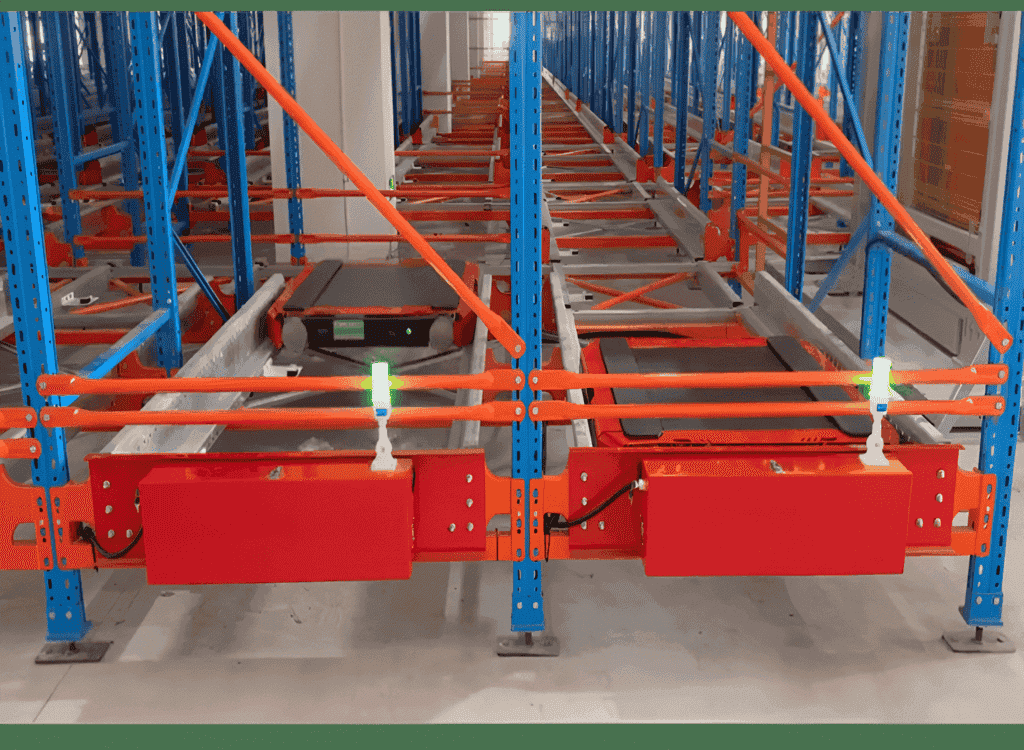
Shuttle systems represent a fundamental rethinking of how pallets move in and out of deep-lane storage. Instead of requiring a forklift to enter the racking structure, a shuttle device travels within the lane to put away and retrieve pallets automatically. The forklift operator simply places a pallet at the face of the rack, and the shuttle does the rest.
How the Shuttle Changes the Forklift Interface
This is the single most important distinction between the two systems: the shuttle handles the put-away and pick operations inside the racking, dramatically reducing the amount of forklift interaction required.
- For put-away: The forklift operator places the pallet at the rack face. The shuttle picks it up and transports it to the next available position deep in the lane. The forklift never enters the rack.
- For retrieval: The shuttle travels to the target pallet, picks it, and delivers it to the rack face. The forklift operator picks it from the face. Again, the forklift never enters the rack.
- Result: Forklift cycle times drop dramatically because operators only work at the rack face—no more driving in, reversing out, or navigating tight lanes. Throughput increases, product damage decreases, and rack damage from forklift impacts is virtually eliminated.
Pick and Load from Any Level
One of the most powerful advantages of shuttle systems is their ability to pick and load from any level of the racking, at any time. Unlike drive-in racking, where lanes must be unloaded sequentially from the bottom up, shuttle systems give you complete flexibility:
- Need a pallet from the top level? The shuttle on that level retrieves it directly—no need to unload the levels below first.
- Need to put away to a mid-level lane? Place it at the face of any level and the shuttle handles it.
- Multiple shuttles, multiple levels: Run shuttles on several levels simultaneously to increase throughput. Drive-in can only have one forklift per lane at a time.
- True FIFO or LIFO: Shuttle systems support both first-in, first-out and last-in, first-out configurations, giving you full control over inventory rotation—critical for food, beverage, pharmaceutical, and other date-sensitive products.
Dramatically Improved Safety
Because the shuttle—not the forklift driver—enters the racking structure, operators are never positioned beneath overhead pallets. This eliminates the single greatest safety risk associated with drive-in racking.
- Seismic safety: In an earthquake, forklift operators are working at the face of the rack, not deep inside it. They are not beneath elevated loads and can evacuate quickly. This is a profound safety improvement for facilities in seismic zones—and a meaningful one everywhere else.
- Reduced forklift traffic inside racks: With forklifts staying at the rack face, the risk of collisions with uprights, rails, and other structural components drops dramatically. This means fewer rack repair incidents, fewer damaged pallets, and a safer overall facility.
- Less operator fatigue: Driving a forklift deep into narrow lanes, carefully positioning pallets on rails, and reversing out repeatedly is mentally and physically taxing. Shuttle systems eliminate this stress, reducing fatigue-related incidents.
Additional Shuttle Advantages
- Higher storage density—Shuttle lanes can be deeper than drive-in lanes because there is no forklift turning radius or visibility limitation.
- Lower total cost of ownership—While the upfront investment is higher, reduced product damage, lower maintenance costs, faster throughput, and fewer forklift hours drive a compelling ROI.
- Path to full automation—4D shuttles are designed from the ground up for fully autonomous operation. The racking infrastructure carries forward, protecting your investment as you scale.
- Cold storage performance—Shuttles excel in freezer environments where minimizing human exposure to extreme temperatures is critical, and where the cost per square foot makes density gains especially valuable.
A Side-by-Side Comparison
| Criteria | Drive-In Racking | 4D Shuttle System |
|---|---|---|
| Forklift enters rack? | Yes—every put-away and pick | No—forklift stays at the face |
| Pallet access | Bottom-up, lane by lane (LIFO) | Any level, any lane (FIFO or LIFO) |
| Operator safety | Driver under loaded pallets | Driver stays outside rack structure |
| Seismic risk | High—operator trapped under loads | Low—operator at rack face, clear exit |
| Product damage | High—forklift contact in lanes | Low—shuttle handles pallets precisely |
| Rack damage | Frequent—forklifts hit uprights and rails | Minimal—no forklift traffic in lanes |
| Throughput | Limited by forklift cycle time | Higher—multiple shuttles, face-only forklift work |
| Inventory rotation | LIFO only | FIFO or LIFO |
| Upfront cost | Lower | Higher—offset by operational savings |
| Path to automation | None | Direct path—built for full autonomy |
The Historical Context
It is worth understanding how we got here. Drive-in racking has been the workhorse of high-density pallet storage in North America for decades. When your only option for deep-lane storage was to send a forklift into the rack, drive-in was the answer—and for many years, it was the only answer.
Shuttle technology existed in Europe and other markets for some time, but it was only when shuttle systems came to America a few years ago that U.S. warehouse operators gained access to a true alternative. The impact has been transformative. Facilities that previously accepted the limitations and risks of drive-in—because there was no other choice—are now retrofitting and new-building with shuttle systems that eliminate those compromises entirely.
The Bottom Line
Drive-in racking still has a place for simple, low-throughput, budget-constrained applications where LIFO is acceptable and the operational limitations are understood. But for any facility that values operator safety, inventory flexibility, throughput performance, and a path to future automation, 4D shuttle systems are the clear modern standard.
The shuttle does the work that used to put forklift drivers at risk. It picks and loads from any level without the sequential constraints of drive-in. It keeps operators out of the rack structure and away from overhead loads. And it provides a foundation for the fully autonomous warehouse of the future.
Contact Bulldog Rack today to discuss which solution is right for your facility—and how our shuttle systems can transform your storage operations.